
QCy™ Signature-Free Quantum-Invariant Blockchain Architecture
HST GLOBAL, INC. INTRODUCES QCy™ SIGNATURE-FREE QUANTUM-INVARIANT BLOCKCHAIN ARCHITECTURE
ADDRESSING ETHEREUM’S POST-QUANTUM PERFORMANCE CRISIS
Virginia Beach, VA May 2, 2026
“Company Files Two Concurrent U.S. Provisional Patent Applications Covering a Ground-Up Signature-Free Blockchain and a QCy™-Based Retrofit for Ethereum — Delivering Quantum-Safe Authentication That Is Faster, Smaller, and Cheaper Than Classical ECDSA With Zero Cryptographic Overhead Per Transaction”
HST Global, Inc. (OTC: HSTC) (“HST Global” or the “Company”) today announced the publication of two companion technical white papers and the filing of two concurrent United States provisional patent applications introducing a signature-free, quantum-invariant blockchain architecture built on the Company’s patented QCy™ (Qwyit Cipher) symmetric-key stream cipher. The first provisional application discloses a complete, ground-up blockchain network in which no digital signature is ever generated, transmitted, stored, or verified at any layer of the protocol stack. The second, concurrently filed provisional application discloses methods for retrofitting the QCy™ architecture onto existing blockchain networks - including Ethereum - to deliver quantum-safe transaction authentication, consensus validation, and decentralized key management without a network-wide hard fork. Together, the two filings offer a direct alternative to the lattice-based post-quantum approach currently being evaluated by the Ethereum community, addressing the performance, cost, and decentralization challenges that have accompanied that transition.
Ethereum, which secures hundreds of billions of dollars in digital asset value, has targeted quantum-safe readiness by approximately 2029. The prevailing approach under consideration replaces Elliptic Curve Digital Signature Algorithm (ECDSA) and Boneh-Lynn-Shacham (BLS) signatures with NIST-standardized lattice-based post-quantum schemes such as ML-DSA. Those schemes introduce signatures of 2,420 to 4,595 bytes - a 37-fold to 71-fold increase over the 65-byte ECDSA signature - along with substantially higher verification costs, loss of signature aggregation at the consensus layer, and increased gas costs for end users.
A Different Approach: Provable Security Without Computational Cost
The QCy™ architecture takes a categorically different approach. Rather than making a mathematical problem harder to solve, the QCy™ cipher ensures the information required to solve it is structurally absent from the ciphertext. The cipher is formally proved to satisfy Claude Shannon’s 1949 Ideal System definition, with security derived from mathematical underdetermination rather than computational hardness. As a result, the security of QCy™ is unconditional, algebraic, and quantum-invariant — meaning no advance in classical or quantum computing can compromise the cipher.
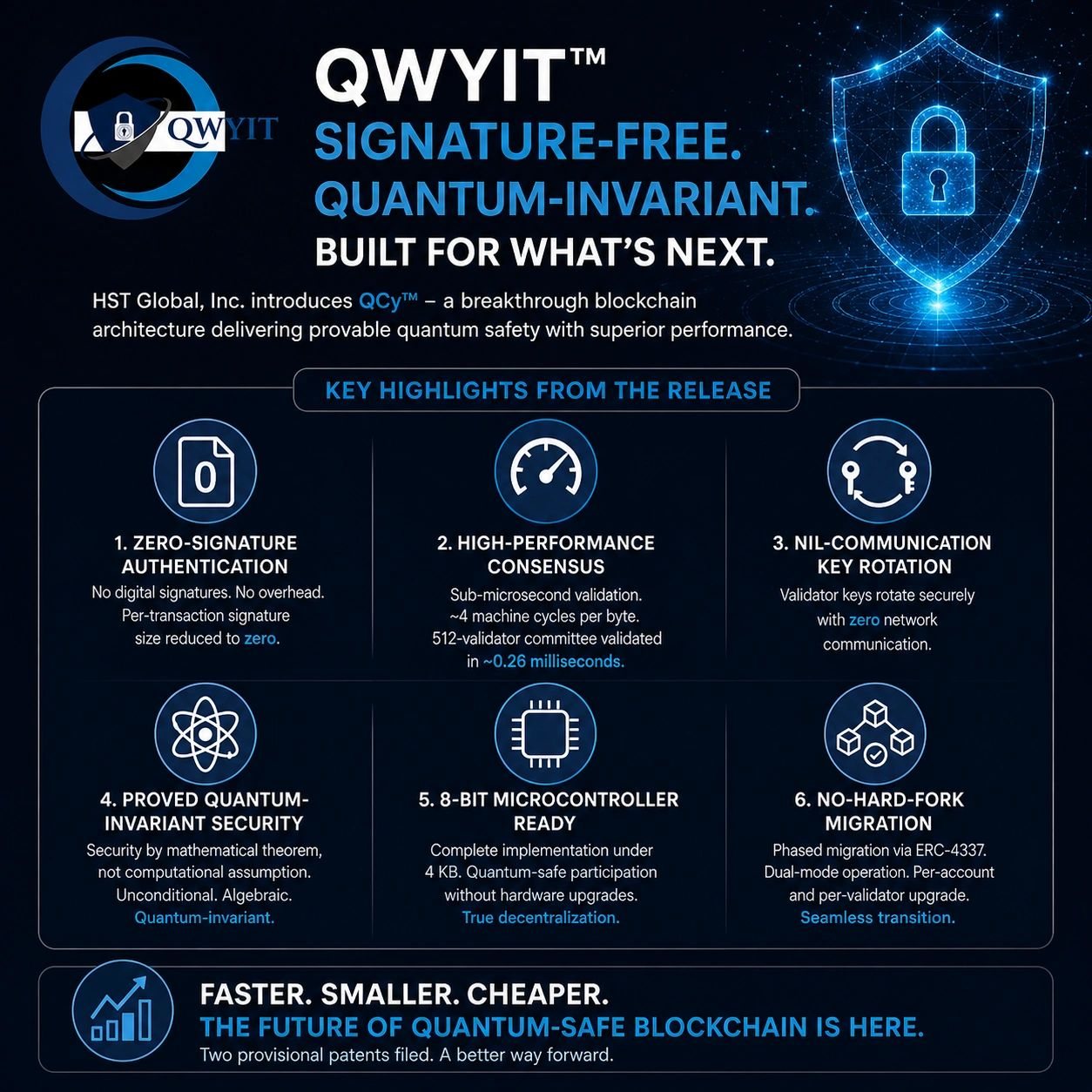
Whether deployed as a native signature-free blockchain or retrofitted onto an existing network such as Ethereum, the QCy™ architecture delivers six specific technical achievements described in the Company’s white paper:
1. Zero-Signature Transaction Authentication.Transactions are authenticated through symmetric decryption alone, eliminating the separate digital signature field entirely. Per-transaction cryptographic overhead is reduced from 65 bytes (ECDSA) or 2,420 to 4,595 bytes (lattice-based post-quantum) to zero.
2. Aggregation-Free Consensus Validation. Validator attestations are authenticated through pairwise decryption without signature aggregation, achieving sub-microsecond per-attestation validation at approximately four machine cycles per byte. At that rate, validation of a 512-validator committee is calculated at approximately 0.26 milliseconds.
3. Nil-Communication Key Rotation. Validator key rotation is performed without any network communication, with both parties independently deriving identical updated key material using only local computation on shared state.
4. Proved Quantum-Invariant Security. Security is established by mathematical theorem rather than computational assumption, satisfying Shannon’s Ideal System definition such that the key equivocation H(EK, QK | Cᵐ, Mᵐ) ≥ 1 bit for all m ≥ 1.
5. 8-Bit Microcontroller Deployment. The complete cipher implementation is under 4 kilobytes and operates on processors as constrained as 8-bit microcontrollers, preserving blockchain decentralization by ensuring that quantum-safe participation does not require a hardware upgrade.
6. No-Hard-Fork Migration. The architecture supports phased migration from classical to quantum-safe authentication without a network-wide hard fork, through dual-mode operation at both the execution and consensus layers with per-account and per-validator upgrade capability via the ERC-4337 account abstraction framework.
Management Commentary
“The blockchain industry has been asked to accept a difficult tradeoff: adopt post-quantum cryptography and pay for it in performance, throughput, and gas costs, or defer the transition and accept a widening window of quantum risk,” said Michael P. Fortkort, Chief Executive Officer and Director of HST Global, Inc. and co-inventor of the QCy™ cipher signature free blockchain and retrofit for Ethereum. “The QCy™ architecture demonstrates that this tradeoff is not necessary. Our approach delivers quantum-safe authentication that is simultaneously faster, smaller, and less expensive than the classical cryptography it replaces, while preserving the operational properties that decentralized networks depend on.”
“By grounding security in mathematical underdetermination rather than computational hardness, and by integrating through the ERC-4337 account abstraction framework, QCy™ enables Ethereum and similar networks to transition to quantum-safe operation gradually, on a per-account and per-validator basis, without a protocol-level hard fork,” added Mr. Fortkort. “Our second concurrently filed application goes further still, disclosing a complete blockchain architecture designed from the ground up with no digital signature at any layer of the protocol stack. Taken together, the two filings give the industry both a migration path for the networks that exist today and a reference architecture for the quantum-safe networks that will follow.”
Reference Implementation
In parallel with the white papers and provisional patent filings, the Company has developed a working reference implementation of the ground-up signature-free blockchain architecture, written in Rust and designated QCy BC Hyper. The reference implementation comprises approximately 96,000 lines of Rust across 21 workspace crates, currently passes more than 1,700 unit and integration tests with no failures, and runs as a multi-validator network on commodity hardware. It is structured as a pre-production reference milestone intended for controlled testnet and pilot deployments, not as a release candidate for unattended production operation; the Company maintains a published list of architectural workstreams that remain open for that posture, including replacement of the reference filesystem storage backend with a mature transactional key-value engine, durable storage compaction, verifiable finality evidence in late-joiner sync, and multi-process end-to-end test infrastructure. The reference implementation supplements rather than substitutes for the technical disclosures in the provisional applications and white papers; qualified parties evaluating the architecture are invited to request access through the Company.
Intellectual Property Protection
The QCy™ cipher and its associated key management architecture are protected by six issued United States patents: U.S. Patent Nos. 10,924,278; 12,192,356; 11,848,928; 11,711,365; 11,711,364; and 11,973,754. The Company has concurrently filed two United States provisional patent applications extending that protection to blockchain architectures. The first, entitled “Signature-Free Quantum-Invariant Blockchain Architecture Employing Symmetric Stream Cipher Intrinsic Authentication,” discloses a complete seven-layer blockchain network in which no digital signature is generated, transmitted, stored, or verified at any layer — with transaction authentication, consensus validation, key management, data availability, network-layer integrity, and transaction privacy all achieved through a single cryptographic mechanism: intrinsic authentication via QCy™ symmetric stream cipher decryption. The second, concurrently filed application, entitled “Quantum-Invariant Stream Cipher Architecture for Blockchain Transaction Authentication, Consensus Validation, and Decentralized Key Management,” discloses methods for retrofitting the QCy™ architecture onto existing blockchain networks, including the phased, no-hard-fork migration path for Ethereum described in the Company’s white paper. Additional provisional applications cover the AIQwyit™ dynamic security platform and nil-communication key management for Disconnected, Denied, Intermittent, and Limited (DDIL) environments.
Two companion technical white papers are available to qualified parties upon request through the Company: “Solving Ethereum’s Post-Quantum Performance Crisis — How the QCy™ Stream Cipher Eliminates the Security-vs-Efficiency Tradeoff Facing Blockchain Networks,” which accompanies the retrofit provisional application; and “QCy™ Native Blockchain Architecture — A Signature-Free, Quantum-Invariant Distributed Ledger,” which accompanies the ground-up signature-free provisional application.
About HST Global, Inc.
HST Global, Inc. is a Virginia Beach, Virginia-based technology holding company specializing in advanced cryptographic and cybersecurity solutions for defense, government, enterprise, and critical infrastructure markets. HST Global is the parent company of Qwyit, LLC, a cybersecurity innovation firm with a portfolio spanning more than 25 years of patented breakthroughs, including the Fast Unbreakable Cipher, Real-Time Trust protocols, Provably Secure Authentication & Encryption (PSAE) engine, and Universal Unbreakable Encryption technologies. Together, HST Global and Qwyit continue to advance the global state of digital security across hardware, firmware, software, financial, communication, and government sectors. For more information, please visit www.HSTGlobal.com
Forward-Looking Statements
This press release may contain “forward-looking statements” within the meaning of Section 27A of the Securities Act of 1933 and Section 21E of the Securities Exchange Act of 1934. Such statements reflect current expectations regarding future events, including anticipated commercial performance, regulatory outcomes, and distribution expansion. Actual results may differ materially due to risks and uncertainties, including regulatory delays, market acceptance, manufacturing capacity, and other factors described in the company’s public filings. The company undertakes no obligation to update or revise any forward-looking statements except as required by law.
Contact:
HST Global, Inc.
www.HSTGlobal.com
509 Old Great Neck Road, Suite 105
Virginia Beach, VA 23454
Email: info@hstglobal.com